My Sister Does Want Us to Help With Her Baby

When parents play favourites, what happens to the kids?
Penulis
-

Banana Professor, Canada Research Chair in Determinants of Kid Development, Owerko Center at the Alberta Children's Hospital Enquiry Plant, University of Calgary
-

Atkinson Chair of Early Kid Development and Didactics and Director of the Atkinson Centre, University of Toronto
Pengungkapan
Sheri Madigan receives funding from Social Sciences and Humanities Research Council, the Canada Research Chairs program and the Alberta Children's Infirmary Foundation.
Jennifer Jenkins receives funding from Canadian Institutes of Wellness Research, Social Sciences and Humanities Inquiry Council, the Bernard van Leer Foundation, Atkinson Charitable Foundation, Lawson Foundation and Margaret and Wallace McCain Family Foundation.
Mitra


Academy of Toronto dan Academy of Calgary memberikan dana sebagai mitra pendiri The Conversation CA.
University of Calgary dan University of Toronto memberikan dana sebagai anggota The Conversation CA-FR.
Lihat semua mitra

Alih bahasa
- Bahasa Indonesia
- English
Many siblings, when they go together as adults, joke about which child was loved the nearly. But is it really a joke or is there an border of truth that yet rankles us?
In i report, researchers asked adults whether their mom played favourites when they were kids. Close to 85 per cent of respondents perceived that she did.
Just surely once we move out of the nest, our annoyance regarding sibling favouritism subsides? No and then. Upset from perceived favouritism appears to be long-lasting.
It is likely that we will fret long into machismo over why a particular sibling got a better deal than we did.
Is sibling favouritism real, or perceived?
It turns out parents do acquit differently with their children and, of course, children have their different thresholds for noticing these differences.

Researchers have studied favouritism both past observing children every bit they collaborate with their parents and by request children and their parents to written report on their interactions. How often do the parent and child laugh or play together? How ofttimes practice they fight or argue?
These ratings are then compared across the dissimilar siblings to determine if one child receives more positive or negative attention than the other.
One of the reassuring findings from these studies is that when the differences in how siblings are treated by parents are small, it has trivial to no outcome.
It is only when the differences are large that we run across links to children's health and relationships.
Parental stress plays a role
Research on all different kinds of relationships shows us that a large function of how we get along with others is almost the fit of personalities. We find ane person easier or more than interesting than another. The same holds for parents and children.
Although most parents dear and nurture all their children, they will inevitably observe that they are more in tune with ane child than another. One child is perhaps a bit more social; another is more ready to anger, a 3rd finds learning easier.
These differences in how parents treat siblings have a basis in children's genes. Parents treat identical twins, who share 100 per cent of their Dna, more similarly than they treat non-identical twins, who share well-nigh 50 per cent of their genes.
The more the personalities of siblings differ, the more than their parents treat them differently.
Another commuter of parenting is, of course, a child's age. Parents collaborate with and field of study their children based on changes in developmental capabilities equally they abound. Age and personality explicate some of the differences in the parental treatment that children perceive.
But while historic period and personality play a part in why one kid gets more from a parent than another, over and to a higher place this are bug of parental stress. When parents experience financial strain, mental health bug or partner conflict, differential parenting or sibling favouritism becomes more than marked.
Impacts on physical and mental well-being
Unfortunately, perceived favouritism can create a dissever between siblings. It is associated with siblings feeling less close to 1 another, both in babyhood and adulthood.
This finding has been established for both perceived, as well as observed favouritism.
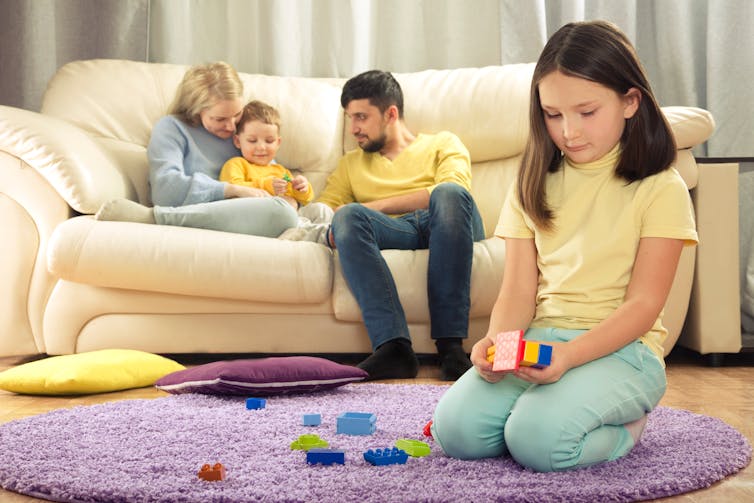
Popular wisdom suggests that the favoured child receives benefits from their special treatment. While this may be the case when favouritism is slight, research suggests that none of the siblings benefit when information technology is more than marked. That is, when favouritism is considerable, information technology is associated with all siblings showing less physical and mental well-being.
Reasons for this are not currently clear. It is possible that children are activated by injustice. Or maybe even when they are favoured they fright falling into the realm of beingness disfavoured.
Simply near reassuring for parents are the findings that parental explanations for why they are treating siblings differently really modify the experience for children. Explanations that focus on their different personalities, ages or needs are associated with lower levels of distress for children.
V tips for fairer parenting
-
Be aware. The showtime pace is to exist aware that it happens, and to seek out assist or support from partners, family unit members, friends or health professionals — to try to understand why it happens. As a reminder, playing favourites is more likely to occur when your stress levels are high.
-
Mind. When your child complains or you lot run into fights between siblings in which they mention one getting more than another, try not to discount it. Be receptive to the child'south feelings and think about why they might exist feeling this way.
-
Provide an explanation. Sometimes, children exercise demand to exist treated differently, similar when one child is sick, hurt or has special needs. When this happens, explicate it to avoid any misunderstanding.
-
Avoid comparison children. While information technology may be a natural trend to say "why can't you lot be more like your sis?" this sets up an unfair comparing. Try to focus on what each child does well, without pitting them against 1 another.
-
Carve out private time for each child. As much as possible, try to find 10 minutes each day to spend one-on-one with each kid and then that each has your full attention. Do any activity that they love to practice with yous.
Pembaca kami
Jumlah pembaca The Conversation sebanyak 18 juta pengguna setiap bulan, dan melalui Creative Commons republikasi menjangkau 42 juta pembaca.
Mau menulis?
Tulis artikel dan bergabung dengan komunitas akademisi dan peneliti yang terus tumbuh dengan lebih dari 142.500 dari 4.312 lembaga.
Daftar sekarang
My Sister Does Want Us to Help With Her Baby
Source: https://theconversation.com/when-parents-play-favourites-what-happens-to-the-kids-110019

Post a Comment for "My Sister Does Want Us to Help With Her Baby"